
The Holy Shroud of Turin, a cloth of undocumented origin, which depicts the image and crucifixion wounds of Christ, has been subjected to numerous historical and scientific inquiries into its authenticity, more so than any other sacred relic in the Catholic Church. Although no Catholic doctrine depends on the authenticity of the Shroud, and even non-Christians accept the historical fact of the Crucifixion without it, the perceived apologetic or counter-apologetic significance of this question has led to the proliferation and entrenchment of some dubious claims and false dichotomies, both by adherents and opponents of authenticity. It is our task here to cut through these claims to their factual and methodological basis, employing our own knowledge of proper historical and scientific method.[1]
For historical analysis, we will give an overview of icons and relics in general, and the particular icons and relics that are supposedly related to the Shroud or even identical with it. The firmly documented history of the Shroud only goes back to the fourteenth century. Attempted reconstructions of its earlier history depend on suppositions that may not withstand scrutiny.
Modern photography of the Shroud (black-and-white in 1898, color in 1969) showed that the facial image was astonishingly realistic and subtle when color-inverted. This raised the possibility, long dismissed by a skeptical age, that the image might be an authentic impression of the body of Christ. The Shroud was subjected to a battery of scientific tests during the 1970s, so that there is arguably more physical data on this than any other relic. The interpretation of the data and the validity of methods used to collect it have been contested in many instances. We will distinguish which of the findings hold up under scrutiny and which do not. In some cases, the findings are correct, but may admit of alternative interpretation.
Scientific interest in the Shroud by secular researchers diminished greatly after the announcement of carbon dating results (1988) that gave a medieval origin (13th-14th century). Since the Shroud did not date to the first century, it could not possibly be an authentic burial cloth of Christ, and all the image studies from the 1970s indicating that the image is not a painting or other artwork must be mistaken. The pro-authenticity scientists, for their part, tried to claim that the radiocarbon dating was wrong, due to defect in methodology or choice of sample. This is a false dichotomy; in fact there are solid grounds for upholding the work of both the image study in 1978 and the carbon dating labs in 1988.
The acceptance of a late dating of the Shroud does not solve all mysteries. For one thing, if it is truly medieval in origin, it would force us to revise our estimation of the technical capabilities and learning of that time. The dichotomy of authentic burial cloth of Christ
or forgery
is also false, as study of the history of icons should show. The fact that the Holy Shroud has withstood serious scientific scrutiny excluding normal forms of artifice, combined with its evident aesthetic and spiritual qualities, shows that it may deserve to be regarded as a holy icon, even if it is not properly a first-class relic.
In the Middle Ages, there were countless relics of the saints, purported to be their authentic bodily remains, garments, or personal effects. These attracted thousands of pilgrims, who venerated these items to honor the saints and beseech their blessings. In many cases, there were miraculous healings credited to these relics, and this was seen as proof of authenticity. It was usually impossible to establish authenticity by historical documentation, except for some relics of relatively recent saints, which might have a documented chain of provenance. Even then, relics could be multiplied, as a garment pressed against another relic was considered to be almost as valuable, for what was important was its proximity to the saint, not its material or historical value as such.
The ability of relics to attract pilgrims and their alms naturally incentivized the creation of fraudulent relics, as well as the uncritical acceptance of spurious relics by innocent error. Sometimes the circumstances in which a relic was discovered or recovered (surviving some calamity), seeming providential or even miraculous, was considered sufficient proof of its authenticity.[2] As relics were primarily means of drawing close to the saints, what counted was their ability to communicate the spiritual blessings of a saint, rather than their historical authenticity.
Relics of the Lord’s Passion and of the Apostles are most highly revered, not only because of the exalted nature of their subjects, but because of their exceptional rarity. Nonetheless, even these relics proliferated to such a degree as to defy credulity. There were far more holy thorns
and splinters of the True Cross than could have ever existed, much less survived from the time of Christ. As a purely historical matter, it is highly implausible that any relics of the Apostolic age survived into the High Middle Ages, except perhaps for the remains of Ss. Peter and Paul under the Roman basilica. Little certain is known of the locations of the deaths of the other Apostles. There is no mention of any relics of the Lord’s Passion until the fourth century, when the emperor Constantine ordered excavations in Palestine. They supposedly discovered the True Cross and important sites such as the Holy Sepulchre, exact knowledge of which was probably lost, if not by the destruction of Jerusalem in AD 70, then almost certainly after the Roman devastation of Judea and expulsion of the Jews that followed the Bar Kochba rebellion in the second century. In the fourth century, there is no mention of any burial cloths of the Lord persisting as relics. These apparently were not among the putative relics recovered by Constantine. Eusebius is conspicuously silent, though he certainly shows interest in such matters.
Relics of the martyrs, i.e., their physical remains, were collected and venerated at least since the fourth century, and possibly as early as the second century, if the Martyrdom of Polycarp is accurate. The purpose of keeping such relics was to commemorate and honor the heroic act of martyrdom, which bore witness to the faith.
In the fifth century, Christians began to make votive portraits of the saints. By the sixth century, many of these icons or painted images were venerated much like relics. Such votive artwork would have been foreign to earlier Christians. In the Roman Empire, the emperor’s image was owed the same worship as the emperor, who was considered divine. Christians and Jews rejected this image-worship
(idolatria) as the gravest of sins. Since the saints were not considered divine, however, there was nothing properly idolatrous about keeping their images.
After some initial controversy, it was admitted that painted images of Christ and the Virgin were licit and even worthy of veneration, as long as no divinity was attributed to these images. There were yet no sculptures or bas-reliefs, for such graven images
were prohibited by divine commandment. Centuries later, even these would be allowed in the West, as long as no divine worship was given to them.
The fifth and sixth centuries were the beginning of a truly literate age, at least for the clergy and monastics, who were the religious teachers of the other classes. They were accustomed to abstract and symbolic thinking, so the ancient pagan mentality that confused images with reality had less of a hold. At the same time, attempts to subject Christianity to Old Testament legalism was rejected as Judaizing,
often with anti-Semitic overtones. Nonetheless, veneration of icons was not accepted peacefully by all, and the opposition to this by some emperors and patriarchs resulted in the famous iconoclast controversies. It was noted by the iconoclasts that, whatever distinctions the educated might make, the populace were inclined to treat icons as though they had powers of their own.
It is around this time that we find some images for which extraordinary claims are made. The Icon of Hodegetria, depicting the Virgin and the child Jesus, was thought to be painted by St. Luke. It was brought back from the Holy Land to Constantinople by Empress Eudocia (c. 440), along with many holy relics from her pilgrimage. In the sixth century, we find icons not made by human hands.
One of these is the Image of Camulania, depicting the face of Christ, which was brought to Constantinople from Cappadocia in 574. This painted image of Christ miraculously appeared to the pagan catechumen Hypatia, but after the earthly life of Jesus. The legend of Veronica’s veil (11th century) did not exist yet.
None of the early icons or relics include a full-length cloth from the time of Christ. The first attestations of such relics do not occur until the twelfth century. One of these is the Holy Tunic of Argentuil (1156), reputed to be Christ’s seamless garment
and to bear his blood stains. Another is the seamless garment
in Trier, also from the twelfth century, and dipped in rubber for preservation.
It is physically implausible that any untreated cloth of such size would secretly survive in its integrity for over a thousand years. Even if it were supernaturally protected from decay (a supposition contradicted by the need to preserve one of these in rubber), we should expect there to be much accidental damage over the centuries. Further, there is a serious problem of provenance. Unlike the True Cross, which would have been buried safely for three centuries until the excavations ordered by Constantine, the true garment
would somehow need to have survived in Christian hands during the centuries of persecution. It is unclear how the persecuted Church could even have come into possession of such a garment, as the Gospels attest it was taken by Roman soldiers. If such a marvel did occur, it is astonishing that no records of the garment’s existence in the first millennium have survived.
Similar objections of physics and provenance can be raised against any reputed Holy Shroud. Accordingly, some have sought to address this problem by identifying an earlier relic with the Shroud of Turin.
The Mandylion, an image of the face of Christ on cloth, is documented to have existed at Edessa (modern Urfa, Turkey, near border with Syria) from 593 to 944 AD, then at Constantinople until at least 1171 AD. At some point, it became associated with a legendary encounter between Christ and King Abgar of Edessa.
The first known mention of the Abgar legend is made by Eusebius (before 325 AD) in his Ecclesiastical History (I,13). King Abgar sent his courier Ananias with a letter to Jesus, beseeching him to heal his incurable disease. Christ’s reply, recorded in a letter, promised that the king, who believed without seeing, would be healed and converted by one of his disciples after he had been taken up to the Father. Eusebius translates both letters in full from Syriac, using copies in the archives of Edessa. He also translates the subsequent Syriac narrative concluding the story, with St. Thomas, after the Ascension, sending Thaddeus, one of the seventy disciples, to heal the king and convert his household. None of this material mentions any image of Christ.
In 384 AD, the pilgrim Egeria visited Edessa, and learned an embellished version of the legend from the bishop. After receiving the letter from Jesus, King Abgar held it up and prayed that the Persians besieging him should not enter the city. The Persians were thwarted by a great darkness preventing them from finding the way into the city, and by the drying up of water they had diverted from the city to their camp. Thus frustrated in their siege, they returned home. The city was likewise protected from subsequent invasions by reading the letter aloud at the gate, driving back enemies. The bishop showed Egeria the gate by which the courier Ananias first brought the letter, and a memorial of King Abgar and his family. The bishop showed Egeria the letters of Abgar and Christ, but she says nothing of any image of Christ.[3]
A much more elaborate version of the Abgar legend appears in the Doctrine of Addai (c. 400 AD). This document contains the same two letters, but embedded in a much longer narrative. It dates the sending of the courier—here identified as Hannan the archivist—to the 343rd year of the kingdom of the Greeks (i.e., the Seleucids), which is 30-31 AD. Hannan met Christ in Jerusalem, at the house of the chief priest of the Jews. After receiving Christ’s reply (recorded in about the same form as previous versions of the letter), Hannan, remarkably, asks the king’s painter to make a likeness of Christ for the king. Abgar receives the image with joy, and the narrative continues with an extended version of the later arrival of St. Addai (Thaddeus), and the healing and conversion of King Abgar and his household. Nothing miraculous is attributed to the painting of Christ, though it is revered for being an authentic likeness.
Procopius of Caesarea, in the second book of his History of the Wars (c. 545, II, xii.), writes that the Edessans were so convinced of Christ’s promise that the city would never be taken by enemies, that they now included this in the letter, and engraved it in this form on the city gate. He adds that when Chosroes (Khosrow) of Persia sought to attack Edessa (in 540), his army lost its way twice, camping in the same place repeatedly. Then Chosroes, approaching Edessa, was afflicted with a swollen jaw, and so made no attempt on the city. Still the Edessans paid tribute so he would spare the countryside.
Writing much later (in 593), Evagrius Scholasticus (Eccl. Hist., IV, xxvii) gives a different account of Chosroes’s assault on Edessa, though he has read Procopius. In Evagrius’s telling, Chosroes in fact laid siege to the city, making many assaults and even raising a mound of earth and timber to the height of its walls. To thwart this last tactic, the Edessans dug a mine under the mound and tried to set the timbers on fire, but there was no air vent by which the fire could be sustained.
In this state of utter perplexity, they bring the divinely wrought image, which the hands of men did not form, but Christ our God sent to Abgarus on his desiring to see Him. Accordingly, having introduced this holy image into the mine, and washed it over with water, they sprinkled some upon the timber; and the divine power forthwith being present to the faith of those who had so done, the result was accomplished which had previously been impossible: for the timber immediately caught the flame, and being in an instant reduced to cinders, communicated with that above, and the fire spread in all directions…
This is the first mention of an Edessan image of Christ which the hands of men did not form.
It is identified with the image received by Abgar (according to the Doctrine of St. Addai). His attribution of Edessa’s deliverance to this image is unmentioned by Procopius (545 AD) and by the Chronicle of Edessa (c. 550 AD), which says only that Chosroes came as far as Edessa, but by the grace of God protecting it, he did no harm in it.
(Chron. Edessa, 105)
This is not an uncommon development for icons. Once an icon earns a reputation for working miracles, its origin is attributed increasingly supernatural circumstances, either by developing a new legend, or giving greater credence to a previously existing legend. The icon definitely existed in 593 AD, but its miraculous origin is derived from an embellishment of the Abgar legend, based on recent belief in the thaumaturgic properties of the image. If we accept that Evagrius’s Edessan image is identical with that mentioned in the Doctrine of Addai, then we should regard the miraculous origin as an embellishment. Otherwise, if it is some different miraculous image, it can no longer be traced back to the time of Christ, nor indeed before the sixth century.
This sacred portrait was lost when Edessa fell in 609 to the Sassanians. In 944, this image reportedly was recovered by the Byzantines in exchange for ending a siege, according to John Skylitzes:
The city of Edessa was besieged by Roman forces, and when the people of Edessa were oppressed by the privations of the siege they sent a delegation to the emperor asking for the siege to be lifted and promising to hand over the sacred mandylion of Christ as a ransom. The siege was lifted, and the likeness of our God was brought to the capital where the emperor had it ceremonially received by the parakoimomenos Theophanes with impressive and fitting pomp.[4]
Evidently the image was held in such great esteem that it would be accepted as ransom for a city. This image is certainly the Mandylion as we know it, for the earliest icon depicting it, in St. Catherine’s Monastery in Egypt, dates from the same time as this event, c. 945.
Ian Wilson (1978) was the first to suggest that the Mandylion (now lost) was the Shroud of Turin, folded over to reveal only the face.[5] Those who hold this hypothesis find apparent support in Gregory Referendarius (944) supposedly claiming that it has the wound in Christ’s side. As Andrea Nicolotti has shown, however, this reading depends on a highly doubtful translation of a difficult passage, where Gregory draws a series of poetic parallels between the Mandylion and Christ’s Passion. It is not at all clear that Gregory is claiming that the Mandylion displayed the full body of Christ or the wound in His side.[6] Recognizing this and other problems, Mark Guscin, who has conducted an exhaustive collection of source documents relating to the Mandylion of Edessa, ultimately abandoned the thesis that this is the same as the Shroud of Turin. In the absence of such an identification, it becomes considerably less plausible that the Shroud, if it were authentic, should have passed so many centuries without witness.
The Shroud’s image, to be sure, has many points of facial similarity with Byzantine iconography, typified by the Christ Pantokrator. It has been suggested that the Shroud was the model for this style, but the reverse could just as well be true, seeing as the Byzantine type had become fixed in the first millennium. It must be remembered that the Orthodox have an exalted view of icons, even those that are professed to be painted by human hand. The iconographer performs a holy task, not mere technique, and the saint is believed to see through the eyes of the icon. Because of this ethos, the iconographer is not free to use an arbitrary style.
The Sudarium of Oviedo, one of many purported veils of Veronica,
is about as old as the Mandylion, dating back to 540 AD. It has been carbon dated to be about a century younger, this discrepancy being attributed to contamination. Its points of facial similarity with the Shroud need not be taken as evidence of the latter dating to the sixth century. After all, such similarity may well be mediated by their common link with the Byzantine style already established by then. It does not have a visible facial image, only blood stains and possibly sweat stains (hence a sudarium
). Presumably this cloth would have lain directly upon the face, so it is strange that this should lack an image (unless the image formation is affected by the different chemistry of the cloths), if both the Sudarium and the Shroud are authentic. There was no tradition of Veronica yet in existence, which is why there is no facial image. The Shroud, on the other hand, possesses such an image, suggesting it postdates the Veronica legend (11th cent.).
Returning to the Mandylion, there is no record of it after the sack of Constantinople in 1204. (It is mentioned by travelers in 1150 and 1171.) It is not mentioned among the spoils of that conquest, though it would have been especially prized. If the Mandylion is not the Shroud of Turin, it is lost. Possibly a small part of this relic was sold by Baldwin II of Constantinople to Louis IX of France in 1241, but even this was lost in the French Revolution.
 A more credible early reference to the Shroud of Turin is found in the Pray Codex (1196) from Hungary. Its depiction of the burial of Christ has several striking similarities with the Shroud. The body of Christ is in the same pose as the Shroud image, with hands crossed at the wrists. The upper layer of the burial covering has a zigzag design that may be a stylized depiction of the Shroud’s distinctive herringbone weave, which periodically alternates in orientation, diagonally up, then down. Most striking of all is the four holes in an L-shaped pattern, both on the upper and lower coverings, resembling the famous
 poker holes
in the Shroud.
Against this identification, several points may be raised. First, it is unclear if the burial covering is supposed to be a cloth, or instead a sarcophagus with its lid. The lower portion, after all, has a pattern of crosses instead of a herringbone weave. Secondly, the resemblance to a herringbone weave is less than impressive, as the pattern seems more like a 1:1 or at best 2:1 weave rather than the 3:1 twill weave of the Shroud.
As for the poker holes,
it has been suggested that these are merely circular decorations, akin to those on the angel’s wing and belt. This is a rather weak claim, since the group of four circles is asymmetric and out of place with the underlying pattern. If it is a decoration, it is one that was started but not completed. The objection that the holes did not appear in the Shroud until the fire of 1532 is demonstrably false.  They are clearly depicted in the Lier shroud copy of 1516, so they were already recognized as a distinctive feature. As Brother Bruno Bonnet-Eymard suggests, they were more likely caused by dripping pitch from a torch than by a poker thrust.[7]
While the Pray Codex is a relatively strong candidate for an early depiction of the Shroud of Turin, at best it would date the Shroud to the late twelfth century, only a century older than the radiocarbon dating. As with the Sudarium of Oviedo, this is close enough to be attributable to moderate contamination. Without the link to the Mandylion of Edessa or something similar, we are hardly better off, since there is still more than a millennium of undocumented history for this supposed first-class relic. In our study of Guadalupe, the argument from silence was recognized as significant for a mere twenty-four year gap (1531–1555). How much more so for a millennium!
Geoffroy the First, count of Charny, lord of Chambery, having served in the crusade of 1346 near Smyrna, asked Pope Innocent VI in 1349 to permit him to found a collegiate church in the small town of Lirey, in the Champagne region. The shroud is not mentioned in this letter. From later records, we learn that he presented the shroud to the canons of the collegiate church of St. Mary in Lirey, for which construction began on 20 February 1353 and the Act of Foundation was on 20 June 1353. The college of canons was recognized by Pope Innocent VI on 30 January 1354. Since there is no record of the consignment of the shroud, we can only infer that it occurred sometime between June 1353 and Geoffroy’s death on 19 September 1356 at the battle of Poitiers. Geoffroy left no record of how he acquired the shroud, though his family later said it was either spoils of war or a reward for valor. The Bishop of Troyes, Henri de Poitiers (d 1370), supposedly forbade veneration of the shroud as a relic, though his 28 May 1356 letter to Geoffroy praises him for all he has done to promote divine worship. A 1357 writ of indulgence makes no mention of the shroud among the list of relics to be venerated at the abbey.  A Lirey pilgrim’s badge discovered in the Seine in Paris depicts the shroud and the coats of arms of Geoffroy and his wife Jeanne de Vergy (d. 1428), indicating that this may date from the 1350s. The Charny family reassumed custody of the shroud after its exhibition around 1355, and retained it until 1389, the year we first have clear documentation about the shroud.
When we get to the firmly documented history of the Shroud, we do not have an auspicious start. King Charles VI writes on 4 August 1389 to the bailiff of Troyes, in response to a letter from the Bishop of Troyes (who was now Pierre d’Arcis, third bishop after Henri de Poitiers). The bishop made known to us that in the collegiate church of Blessed Mary of Lirey, in Champagne, in the diocese of Troyes, there was indeed a cloth made by hand and artificially depicted in the figure or likeness and commemoration of the sacred Shroud, in which the most precious body of our Lord Jesus Christ the Savior had been wrapped after his most holy passion, and that to the aforesaid church for the said cloth the people of Champagne and the surrounding countries, not fearing to commit idolatry, flocked abundantly every day…
The beloved and faithful Geoffrey of Charny, knight
(i.e., Geoffroy the Second), had been granted by the king permission by royal warrant (salve gardie) to possess and exhibit this cloth without being hindered by anyone. The knight notified the bishop of this exhibition, and then proceeded to show the aforementioned cloth with lit torches and the priest donning his priestly vestments, as if it were the true Shroud of Christ, to all and sundry who approached there and who, because of the solemnity set before, erroneously believed that it was the true Shroud of Christ, mixing idolatry with the illusion and irreverence of holy mother Church and the orthodox faith, the danger of the souls who also flocked there, as the said bishop said, begging that a remedy be provided for him.
In response, the king ordered the bailiff to obtain the cloth and confiscate it on behalf of the king, and cause it to be kept and preserved under our same hand in another church town of Troyes or elsewhere in a certain safe and honorable place, until we shall have otherwise ordered it,
pending a hearing of the parties. On 15 August, the dean told the bailiff he did not have the key to the treasury, so instead the bailiff sealed the treasury doors to prevent removal of the cloth.
The dispute was escalated to the Avignon antipope Clement VII (Robert of Geneva). In January 1390, Clement issued letters to all parties, deciding the matter. The bull opens by indicating that the Apostolic See has the right to modify its grants according to expediency. Recounting what was explained by Geoffroy II de Charny (d. 1398), his father had caused a certain figure or representation
of the Shroud of our Lord to be placed in the church of St. Mary of Lirey, which he himself founded, and that finally, because of wars and plagues, also at the command of the ordinary of the place and for other certain reasons, was transferred from the said church of Blessed Mary to another more secure place and had remained decently hidden until then and venerably guarded.
Recently Geoffroy II had obtained permission from a cardinal, who was a papal legate, to restore the aforementioned figure or representation
to the church in Lirey, for the sake of the aforesaid church’s decorum, the devotion of the people and the increase of divine worship.
He could display this figure in a suitable place in the church without permission of the diocesan bishop. The bishop Pierre of Troyes ordered the rectors of parish churches not to make any mention of the Shroud of Jesus Christ, the figure or representation thereof in their churches or sermons, whether for good or for evil; and finally he had forbidden the beloved son, the dean of the aforesaid church of St. Mary, from showing the said figure or representation to anyone under penalty of excommunication.
This last act ran afoul of what had been granted by papal authority, so the dean appealed to the recognized pope in Avignon. Clement confirmed the permission to exhibit the same figure or representation
publicly, and the bishop was not to speak against this. Nonetheless, in order to remove all matter of error and idolatry, we wish and in accordance with the apostolic authority of the present documents have decreed that, whenever the said figure or representation is to be shown to the people from now on, the dean and chapter of the aforesaid and other ecclesiastical persons showing this figure or representation and present at this kind of display, as long as the display itself lasts, shall not in any way wear caps, surplice, white, raincoats or any other ecclesiastical garments or vestments, nor shall they perform other solemnities which are usually done in the display of relics, and that therefore no torches, torches or candles shall be lit, nor shall any lights be used there; and that showing the said figure, when a greater multitude of the people has gathered there, publicly declare to the people and say in an intelligible voice, all fraud ceasing, that the aforesaid figure or representation is not the true Shroud of our Lord Jesus Christ, but a certain picture or table made into a figure or representation of the Shroud, which is said to be that of our Lord Jesus Christ.
Clearly, the pope permitted the display of the shroud only on condition that it was not to be treated as a relic or the authentic Holy Shroud. In fact, the canons were expressly commanded to disavow its authenticity when large crowds were gathered. Bishop Pierre d’ Arcis (d. 1395) had a more strongly negative view of the shroud and the dean of canons, considering the latter to be motivated by avarice. This is clearly indicated in his draft letter to Clement VII, which was published by its discoverer Ulysse Chevalier in 1900 and is still in the Bibliothèque Nationale de Paris, in two drafts.[8] 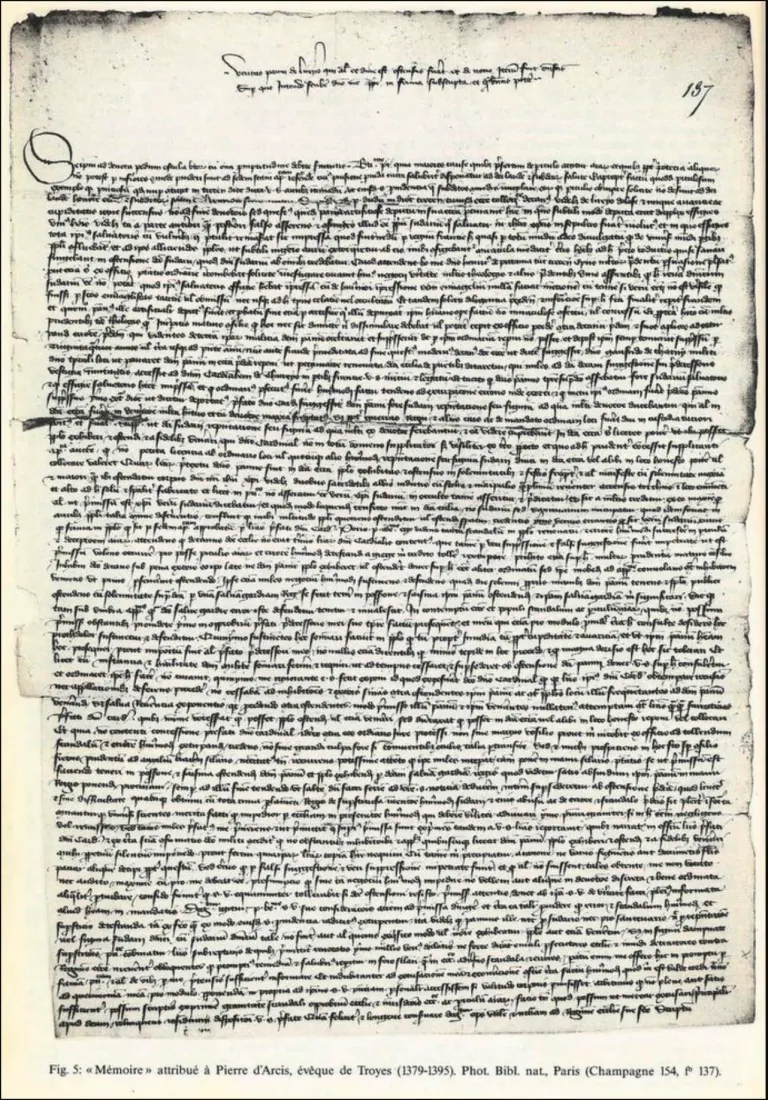 The letter is undated. Chevalier’s estimation that it was written in late 1389 seems likely, given the order of events outlined above, though it might also have been written in response to the judgment of January 1390, if the bishop thought this was issued without his side having been heard. Indeed the pope’s 8 January letter to the bishop of Troyes only mentions Geoffroy’s petition to enforce the royal warrant to possess and exhibit the cloth, and orders the bishop not to impede this exhibition, under pain of excommunication. The bishop’s draft letter seems to indicate that he has heard of the letters from the pope, but has not yet received copies, so he fears that the exhibition has been permitted to continue without restriction.
The bishop prevents the facts of the case thus:
Some time since in this diocese of Troyes the Dean of a certain collegiate church, to wit, that of Lirey, falsely and deceitfully, being consumed with the passion of avarice, and not from any motive of devotion but only of gain, procured for his church a certain cloth cunningly painted, upon which by a clever sleight of hand was depicted the twofold image of one man, that is to say, the back and front, he falsely declaring and pretending that this was the actual shroud in which our Saviour Jesus Christ was enfolded in the tomb, and upon which the whole likeness of the Saviour had remained thus impressed together with the wounds which He bore. This story was put about not only in the kingdom of France, but, so to speak, throughout the world, so that from all parts people came together to view it. And further to attract the multitude so that money might cunningly be wrung from them, pretended miracles were worked, certain men being hired to represent themselves as healed at the moment of the exhibition of the shroud, which all believed to the shroud of our Lord. The Lord Henry of Poitiers, of pious memory, then Bishop of Troyes, becoming aware of this, and urged by many prudent persons to take action, as indeed was his duty in the exercise of his ordinary jurisdiction, set himself earnestly to work to fathom the truth of this matter. For many theologians and other wise persons declared that this could not be the real shroud of our Lord having the Saviour’s likeness thus imprinted upon it, since the holy Gospel made no mention of any such imprint, while, if it had been true, it was quite unlikely that the holy Evangelists would have omitted to record it, or that the fact should have remained hidden until the present time. Eventually, after diligent inquiry and examination, he discovered the fraud and how the said cloth had been cunningly painted, the truth being attested by the artist who had painted it, to wit, that it was a work of human skill and not miraculously wrought or bestowed. Accordingly, after taking mature counsel with wise theologians and men of the law, seeing that he neither ought nor could allow the matter to pass, he began to institute formal proceedings against the said Dean and his accomplices in order to root out this false persuasion. They, seeing their wickedness discovered, hid away the said cloth so that the Ordinary could not find it, and they kept it hidden afterwards for thirty-four years or thereabouts down to the present year.
Wicked motives are imputed to the original dean of canons, though not to the greatly esteemed Geoffroy the First. There is no record of any inquisition initiated by Henri de Poitiers, though Pierre d’Arcis indicates this may have been aborted due to the disappearance of the shroud. This would have occurred c. 1355, about thirty-four years before its reappearance in 1389.
A recently discovered text of the illustrious Nicolas Oresme, dated between 1370 and 1382, corroborates the claim that the shroud in Champagne was a well-known fraud. While discussing the credibility of wondrous phenomena, Oresme writes: I do not need to believe anyone who claims:
[9] Oresme imputes the same motive as Pierre d’Arcis, and does so as if it were a well-known example.
Someone performed such miracle for me,
because many clergymen thus deceive others, in order to elicit offerings for their churches. This is clearly the case for a church in Champagne, where it was said that there was the Shroud of the Lord Jesus Christ, and for the almost infinite number of those who have forged such things, and others.
The bishop claims that the cardinal’s approval to display the cloth was obtained by deception, namely by suppressing the facts that the said cloth at the time above referred to was asserted to be the shroud of our Saviour, and that it bore the Saviour's likeness imprinted upon it, and that the Ordinary had taken action against the canons in order to stamp out the error which had arisen, and that the said cloth for fear of the Ordinary had been hidden away, nay even, it is said, conveyed out of the diocese.
Even Geoffroy II admitted that the command of the Ordinary
was one reason for the cloth’s removal. The bishop represents the current dean as the one with fraudulent intent, with the knight acting at his direction in this matter. In any event, the cardinal only granted that the cloth can be displayed in the church, not, to the bishop’s understanding, that it can be publicly exhibited and venerated.
And under cover of this written authority the cloth was openly exhibited and shown to the people in the church aforesaid on great holidays, and frequently on feasts and at other times, with the utmost solemnity, even more than when the Body of Christ our Lord is exposed; to wit, by two priests vested in albs with stoles and maniples and using the greatest possible reverence, with lighted torches and upon a lofty platform constructed for this special purpose; and although it is not publicly stated to be the true shroud of Christ, nevertheless this is given out and noised abroad in private, and so it is believed by many, the more so, because, as stated above, it was on the previous occasion declared to be the true shroud of Christ, and by a certain ingenious manner of speech it is now in the said church styled not the sudarium but the sanctuarium. which to the ears of the common folk, who are not keen to observe distinctions, sounds much the same thing, and crowds of people resort there as often as it is shown or is expected to be shown, under the belief, or more truly the delusion, that it is the true shroud.
In response, the bishop forbade the dean to exhibit the cloth to the public, on pain of excommunication. This was defied, and the knight obtained a royal warrant (salvagardia) to possess and exhibit the cloth, as we saw earlier. The bishop asked the knight to suspend the exhibition until the pope ruled on the matter, but he paid no heed and instead made the same partial representations to the pope that he had to the cardinal. This is when the bishop, in view of the royal warrant, asked for the king’s officers to assume custody of the cloth. This was granted after he presented to the parlement the superstitious origin of this shroud.
The bishop learned, to his distress, that the pope had issued a letter (lictera) confirming the cardinal’s permission to display the cloth for the veneration of the faithful; while, as I hear—for I have not been able to procure a copy of the said letter—perpetual silence is enjoined upon myself.
This seems to refer to the January 1390 letters from the pope, indicating that this draft was also written about the same time, yet before the bishop actually received his letter. Once he did receive it, he may have been dissatisfied that the exhibition was permitted at all, but heartened that its veneration as a relic was expressly prohibited, and that its authenticity must be loudly denied in front of large audiences.
We do not know if any version of this letter ever reached Clement. If it was drafted after the judgment of January 1390 was issued, its receipt by the bishop may have eliminated the need for further response. He indicates that its contents were previously presented to the royal parlement. There is no reason to doubt his belief in the correctness of the presented facts. He had no sensible pecuniary motive, as the pilgrimages to Lirey would only benefit his diocese, and he made no attempt to appropriate the shroud for his own use. His concern about error and idolatry was shared by others, including the king and the antipope in Avignon. Clement later required that any income from pilgrims be used only for the upkeep of the church building.
Per decree of the Fourth Lateran Council (1215), no recently discovered relic can be venerated without the approval of the Roman Pontiff.[10] Tellingly, Geoffroy II did not ask the antipope to recognize the shroud as a relic, which would have precipitated an inquiry into its origins. He was satisfied to have it exhibited and attract pilgrims. As far as we can tell, from the responses of Charles VI and Clement VII, he made no claim to them about its authenticity.
In 1418, the Shroud of Lirey was moved to a castle in Montfort, Doubs for protection during the Hundred Years’ War. Margaret de Charny, granddaughter of Geoffroy, claimed ownership of the shroud, refusing to return it to Lirey and instead putting it on exhibition elsewhere. In 1453, she gave it to the House of Savoy in exchange for an estate, and it was later moved to the newly built Sainte-Chapelle in Chambéry (late 15th cent.), where it is attested as early as 1502. In the legal disputes over ownership between Margaret and the canons in Lirey (1443-1459), the question of authenticity was not raised. Margaret claimed her grandfather acquired it as spoils of war. The canons excommunicated her in 1457 for failing to return the shroud; this was lifted in 1459 when her half-brother provided compensation. By 1500 the controversy was forgotten and the shroud was revered as though authentic. There is no point in time when the shroud was formally granted the status of relic. In 1506, Pope Julius II speaks of the shroud matter-of-factly as authentic, following his predecessor Sixtus IV.
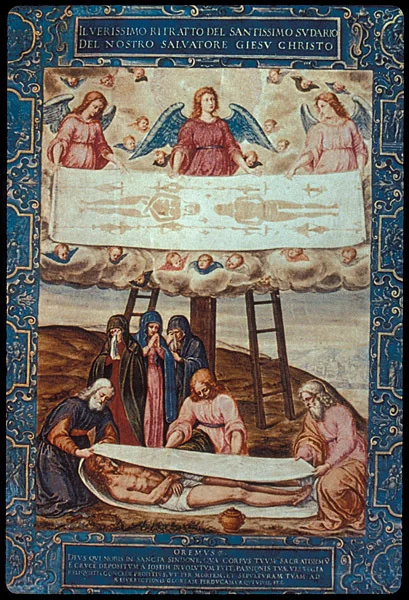 The earliest extant painting of the Shroud is Giulio Clovio’s Descent from the Cross (c. 1540). The aforementioned Lier shroud, a copy of the Shroud which includes red marks for the poker holes, is dated 1516.
Another well known relic was the Holy Shroud of Besançon, with an earliest definite attestation in 1523. It was destroyed in 1794. It is styled similarly to the Shroud of Turin, but with a front view only. The similarity, with a negative reddish image, might give cause to suspect it was a copy of the Shroud in Lirey. Yet this shroud may have been of equal antiquity, as it may have been known as early as the thirteenth century. Supposedly, it was destroyed in the cathedral fire of 1349, then found again, and it revived a dead man, proving its authenticity.
 From an extant painting of the Shroud of Besançon, dated 1634, we can see it is not identical with the Shroud of Turin’s frontal image. The hands are crossed at the wrists rather than the palms, and there are fewer wounds, only the canonical five, marked as red circles. The hand wounds are closer to the palms than the wrists. This painting has the wound on the figure’s left side, just as on the engraving in Jean-Jacques Chifflet’s 1624 comparative tract on the two shrouds. Yet the image is supposed to be an impression, so this would actually represent a wound on the body’s right side, in accordance with tradition.
Some authors have claimed that Bishop Pierre d’Arcis’s 1389-90 memorandum asserting the Shroud was painted actually refers to the Shroud of Besançon. There is no solid evidence for this hypothesis, and the memorandum itself contradicts this, for the bishop says it has a double image of a crucified man, whereas the Besançon shroud has only a frontal image. Also, the bishop says the cloth was displayed at Lirey, and had been exhibited about thirty-four years earlier, i.e., 1355, so he is certainly speaking about the Lirey shroud. Besançon is over 225 km distant by road from Lirey.
In 1578, the House of Savoy moved the Shroud from Chambéry to its final home in Turin, confirming its provenance as the Shroud of Lirey. At the Sainte-Chapelle in Chambéry, painted and woven copies of the shroud were used for liturgy and display after the original shroud had departed. Some 19th-century authors later confused these references as a rival authentic shroud. The only reputedly authentic shroud of Chambéry
was that of Lirey, which resided in the Sainte-Chapelle from 1502 to 1578. There is no missing rival shroud of Chambéry
for which to account, notwithstanding some mistaken claims that this was destroyed during the Revolution. None of the copies after 1578 were ever officially or popularly regarded as authentic relics.
 A 16th-century painted copy in a prayer book of Johann von Erlach (1474-1539) shows the famous
 poker holes
but none of the damage from the 1532 fire, indicating that the painting antedates the fire, as do the poker holes. A likely date for this painting is 1512, when von Erlach met the Duke of Savoy. The Belgian Lier copy from 1516, mentioned previously, likewise shows the same poker holes. Unlike other copies, this one accurately shows the image in shading, rather than as a stark outline.
The shroud copy in Xabregas, a suburb of Lisbon, is first mentioned in a work dated 1651-57. In 1709, someone maintained it might be the original Shroud, or at least a miraculous reproduction, impossible to distinguish from the original. For others, the Xabregas copy is evidence that it was possible to reproduce the Lirey shroud’s image with the techniques of that time.
A seventeenth-century copy in the Monastery of Silos, Spain, is not a very accurate drawing, but the wounds on the legs are accurate. Paintings of the shroud in the sixteenth and seventeenth centuries general show a much more pronounced image, a solid red imprint, rather than the faint image known from 1898 onward, though the Von Erlach prayerbook is a notable exception.
By the late eighteenth century, the Holy Shroud of Turin was one of several highly reputed burial cloth relics of Christ, the others being that of Besançon and that of Cadouin, which bore no image, and was brought to France in 1112 by a knight returning from the First Crusade. In 1934, decipherment of the cloth’s Kufic inscriptions proved it was not a burial shroud, but a Fatimid-period Islamic textile, woven in Egypt around 1090-1120. There were other reputed holy shrouds of secondary importance and renown. From the seventeenth century onward, the House of Savoy forcefully promoted the Shroud of Turin as the true burial shroud of Christ, so even the Besançon Shroud fell into relative disrepute, as its differences from the Turin Shroud were considered marks against its authenticity. It increasingly became regarded as a copy of the Turin Shroud, though we have noted some significant differences. When it was destroyed in 1794, the Church made no protest, as it was no longer considered authentic.
The failure to authenticate rival shrouds is not necessarily a cause for questioning the Shroud of Turin, as logically there can only be one authentic burial shroud of Christ. Nonetheless, the claims for its authenticity were not grounded in a refutation of the long-forgotten assertion that it was painted, nor were modern scientific analyses yet available. Its provenance prior to the fourteenth century could not be established, and the credulity with which inferior copies were received demonstrates that popular belief is no hallmark of authenticity.
If we were to evaluate the shroud’s authenticity on the basis of historical evidence, our judgment would be resoundingly negative. The earliest testimonies from ecclesiastical authorities disavow that it is a true relic, and Nicolas Oresme cites it as a well-known fraud. The early promoters of the shroud offered no reason for believing it to be authentic, as it is utterly devoid of provenance. Indeed, they did not even try to claim authenticity to ecclesiastical authorities in the fourteenth century. Neither Scripture, nor Catholic tradition, nor the historical record give us any reason to expect that the authentic burial shroud of Christ was preserved for over a millennium or that it depicted the image of the Crucified.
Part II Coming Soon
[1] My own qualifications, if not unique, are a fairly rare combination: graduate-level physics and medieval history, and a sufficiently advanced knowledge of chemistry and statistics to understand and interpret the relevant papers.
[2] This was the case with many Spanish icons and the Holy Lance found in Antioch during the First Crusade (1098).
[3] The Pilgrimage of Etheria, M.L. McClure and C.L. Feltoe, ed., trans. (London: Society for Promoting Christian Knowledge, 1919), 30-35.
[4] A Synopsis of Byzantine History, 811–1057, trans. John Wortley. Cambridge Univ. Press, 2010. pp.231-232.
[5] Ian Wilson. The Turin Shroud. (London: Gollancz, 1978)
[6] Andrea Nicolotti. From the Mandylion of Edessa to the Shroud of Turin. The Metamorphosis and Manipulation of a Legend. (Leiden: Brill, 2014)
[7] Bruno Bonnet-Eymard. The Physics and Chemistry of the Holy Shroud, Contre-Reforme Catholique, No. 218, Eng. ed., p. 17 (April 1989).
[8] Ulysse Chevalier. Étude Critique sur l’origine du St. Suaire de Lirey-Chambéry-Turin. (Paris: Alphonse Picard, 1900). Also has cited letters from Charles VI and Clement VII. Chevalier explicitly notes that the d’Arcis memorandum is undated. The title and text of the document can be confirmed in images of the original. Bibliothèque Nationale de Paris, Collection de Champagne, v. 134, folio 138 & v. 154. folio 137.
English translation of d’Arcis memorandum: Herbert Thurston. The Holy Shroud and The Verdict of History
The Month, Volume CI (1903), pp.17-29. English excerpts follow Thurston except in one place, where I prefer letter
as a more exact translation than Brief.
[9] Nicolas Sarzeaud. A New Document on the Appearance of the Shroud of Turin from Nicole Oresme: Fighting False Relics and False Rumours in the Fourteenth Century.
Journal of Medieval History, 2025, v. 51(5), pp.604-621. https://doi.org/10.1080/03044181.2025.2546884
[10] Some sources, following an error in the old Catholic Encyclopedia, misidentify the council as that of Lyons (1274), which did not discuss relics. In fact, the synod of Exeter (1287) does not name the general council, though it repeats the language of the Fourth Lateran: Idcirco in Concilio generali provide novimus esse prohibitum, ne quis Reliquias de novo inventas, publice venerari praesumat, nisi a Romano Pontifice prius fuerint approbarae.
© 2025 Daniel J. Castellano. All rights reserved. https://www.arcaneknowledge.org
| Home | Top |